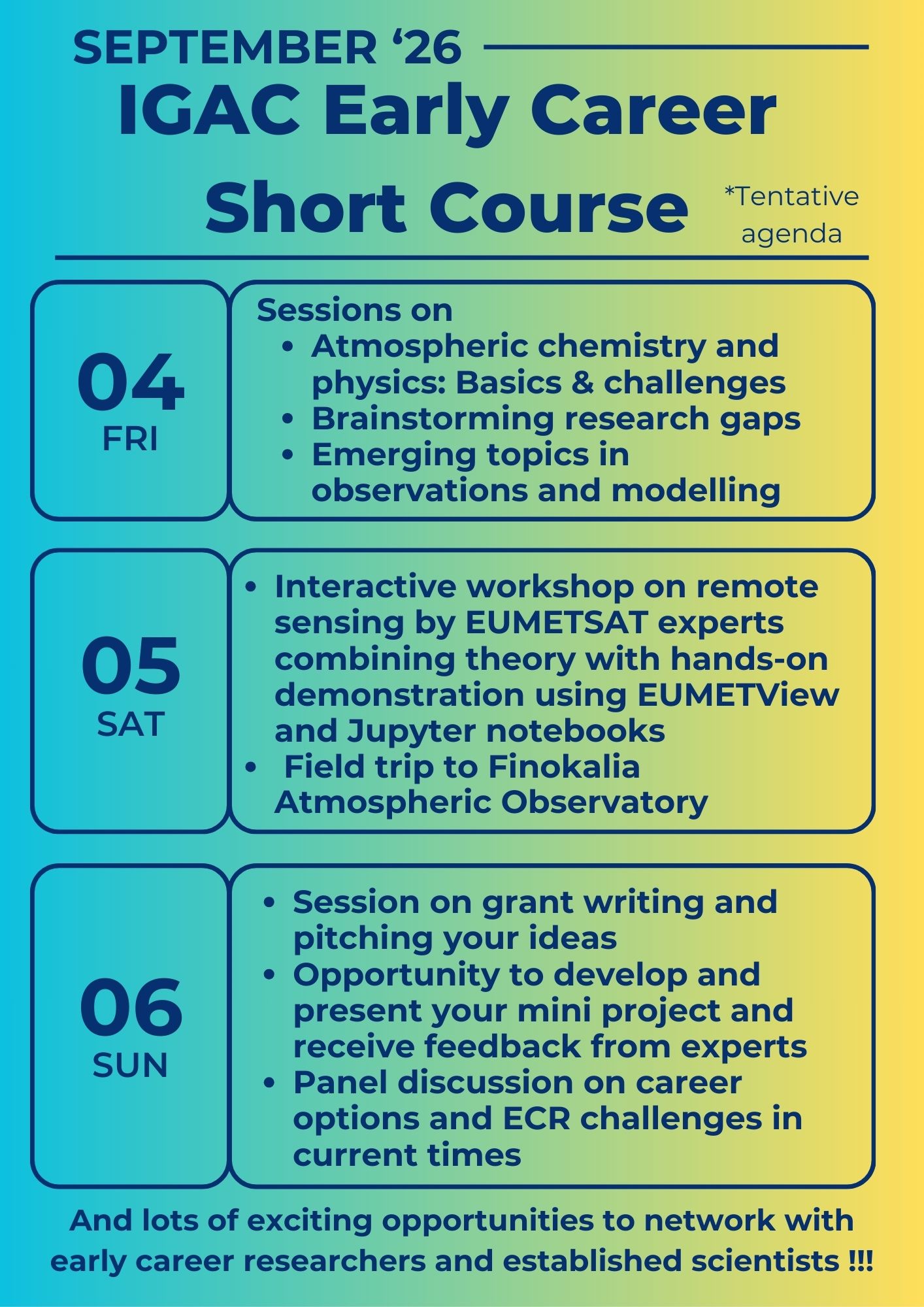
Early Career Short Course
Emil Varghese, Center for Study of Science, Technology, Policy (CSTEP), India (Co-chair)
Emil Varghese is a Senior Research Associate in the Air Quality sector at the Center for Study of Science, Technology, Policy (CSTEP), a leading policy think tank in India. Her research interests focus on air quality observations, with experience spanning real-time bioaerosol monitoring, characterisation of the type and diversity of pathogenic and useful bacterial and fungal bioaerosols, identification of microplastics, and the application of low-cost air quality sensors for hotspot identification. She currently plays a pivotal role in evaluating the performance of low-cost sensors at the India Sensor Evaluation and Training (Indi-SET) facility.
Karn Vohra, University of Birmingham, UK (Co-chair)
Karn Vohra is a research fellow in air quality modelling at University of Birmingham (UK) and an honorary research fellow at University College London (UK). He makes extensive use of ground- and space-based observations, and state-of-knowledge chemical transport and health risk assessment models to improve our understanding of the influence of unregulated and emerging air pollution sources on atmospheric chemistry and public health.
Chi Nguyen, Nagoya University, Japan
Chi Nguyen is currently a PhD student in the Department of Earth and Environmental Sciences, Graduate School of Environmental Studies, Nagoya University. He is also working as a Research Assistant at the National Institute for Environmental Studies, Japan. His research focuses on integrating satellite measurements, ground-based remote sensing (Pandora spectrometer), and chemical transport modeling (GEOS-Chem model) to improve understanding of air pollution and emission sources.
Danny Leung, NSF NCAR, USA
Danny Leung is a project scientist in the Atmospheric Chemistry Observations and Modeling Laboratory (ACOM) at the NSF National Center for Atmospheric Research (NCAR) in Boulder, Colorado, USA. Danny works on process model developments of aerosol emissions, transport, and chemistry, in the Community Earth System Model (CESM/CAM-Chem/MUSICA). He focuses on modeling desert dust, pollen, and particulate nitrate, and their impacts on radiation and cloud forcings.
Lexia Cicone, MIT, USA
Lexia Cicone is a PhD student in the Earth, Atmospheric and Planetary Sciences Department at the Massachusetts Institute of Technology working with Noelle Selin. Her work centers on understanding the sources, chemical transformations, and impacts of toxic air pollutants, particularly polycyclic aromatic hydrocarbons (PAHs). She uses a global chemical transport model, GESO-Chem, to investigate how these pollutants are distributed in the atmosphere, how they interact with climate systems, and how they affect human health. Her research aims to inform environmental policy and public health interventions.
Noribeth Mariscal, Max Planck Institute for Meteorology, Germany
Noribeth Mariscal is a postdoctoral researcher at the Max Planck Institute for Meteorology in Hamburg, Germany. She earned her Ph.D. in Civil Engineering and Urban Sustainability from Wayne State University in 2025, where her work focused on ozone atmospheric chemistry in urban environments through high-resolution global modeling approaches. Noribeth’s work combined high-resolution global chemistry-climate modeling with observational data to investigate ozone production and loss processes, precursor sensitivity, and the role of emissions and transport, mainly using the Community Earth System Model (with CAM-Chem and MUSICAv0 configurations).
Pablo Lichtig, Argentinean National Commission for Atomic Energy (CNEA), Argentina
Pablo Lichtig is a research scientist in the Atmospheric Chemistry Division of the Argentinean National Commission for Atomic Energy (CNEA). He has worked with filter observations and chemical characterizations of fine particulate matter (PM2.5) and modeling, both regional (WRF-Chem) and global with regional refinement (MUSICAv0), with special focus on carbon monoxide as a way to evaluate the origins of pollution in South America. He is a core developer of MELODIES-MONET, a model evaluation tool using observations, to which he added modules for evaluation with satellite products such as TEMPO and TROPOMI, and the ground based remote sensing PANDORA network.
Ryan Pound, University of York, UK
Ryan Pound is currently an early-career postdoc working at the Wolfson Atmospheric Chemistry Laboratories - University of York. His research focuses on improving the representation of ocean-atmosphere interactions in the open-source global chemistry transport.